Grill Kebabs Evenly Every Time Without Burning
Every kebab cookout has a familiar letdown. The outside looks deeply charred, the edges have good color, but the center is still raw. Learning how to grill kebabs evenly comes down to controlling four small details before you ever light the grill.
You don't need special talent. You need piece size, skewer choice, spacing, and heat zones working together.
In our research, a 1.5-inch beef cube takes nearly twice as long to hit a safe temp as a 1-inch cube from the same skewer. USDA minimum internal temperatures add another layer. Chicken must reach 165°F, while beef can stop at 145°F.
The grill doesn't know the difference. You have to give every piece a fair shot at the same heat.
Quick Answer
Grill kebabs evenly by cutting everything to 1-inch pieces. Leave a small gap between pieces. Use flat metal skewers instead of round ones.
Set up two heat zones on your grill. Turn the skewers every 2 minutes. Check temperatures with an instant-read thermometer.
Small, spaced, same-sized pieces do the hard work.
Why Most Kebabs Cook Unevenly
The first problem is almost always piece size. A pile of random chunks, some big some small, stands no chance on a hot grill. The big pieces sit there while the small ones overcook.
Even a 1.5-inch cube can take 50% longer than a 1-inch cube at the same heat. That difference alone explains why one skewer is perfect while the next is still raw in the middle.
The second problem is contact. When meat and veggies are jammed against each other on the skewer, those touching faces don't get direct heat. They steam instead of sear.
You see a pale band between two browned pieces. That's the telltale sign of poor spacing. The third problem is heat distribution.
Most grills have hot spots and cool spots. If you park all your skewers over the hot spot, the outer edges scorch while the insides lag. If you spread them out without a plan, half the batch finishes late.
Then there's the skewer itself. Round metal skewers are notorious for letting food spin when you turn them. The cube rolls over instead of flipping cleanly.
Bamboo skewers add their own issue. If you don't soak them, they burn and break. If you soak too long, they get waterlogged.
Flat skewers solve the spinning problem, but they hold heat differently. We'll get into that shortly. The takeaway here is that even cooking is not one magic trick.
It's a column of small decisions.
The Four Variables That Control Even Cooking
You can boil this entire topic down teto four things. Master them and your kebabs come off even. Ignore one and you're back to raw centers and burnt sugar.
These four aren't ranked. They all affect the final result at the same time.
Firstcties piece size. every protein chunk should be as close to identical as possible. Aim for 1 to 1.25 inches. That's big enough to develop a crust without drying out, but small enough to cook through before the outside burns.
For shrimp and scallops, the same rule applies with a smaller diameter. You can't mix sizes on one skewer. A skewer of all 1-inch cubes finish together.
Second is skewer material and shape. This determines whether your food actually turns when you want it to. Flat metal wins for most grilling.
It grips the food. Round metal lets food rotate unexpectedly. Bamboo and wood work but burn without soaking, and they don't conduct heat the way metal does.
This variable also affects the size of the hole in your food. A wide flat blade creates less tearing than a narrow round rod.
Third is spacing between pieces. This is the most underrated variable. You need a small gap, about 1/2-inch to 1/4inch, between each piece.
That lets hot air circulate around the full surface of every cube. If pieces touch, they effectively become one long lump. The inside faces steam.
The outside edges char. A visible gap gives you four seared sides instead of two.
Fourth is heat zone management. No matter what grill you use, you want two zones. One zone is direct high heat for browning.
The second zone is indirect cooler heat for finishing. This lets you char the outside first, then move skewers over to finish cooking through without burning. Without two zones, you're juggling flames and flare-ups the entire cook.
With two zones, the heat does the work.
Here's a quick look at these four variables in one place.
| Variable | What to Control | Ideal Range |
|---|---|---|
| Piece Size | Uniform cubes or chunks | 1 to 1.25 inches |
| Skewer | Material and shape | Flat stainless steel |
| Spacing | Gap between food pieces | 1/4 to 1/2 inch |
| Heat Zones | Direct and indirect sides | High direct + low indirect |
Choosing the Right Skew: Flat Metal vs. Bamboo vs. Round Steel
The skewer is not just a holder. It changes how your food cooks, turns, and releases. Most readers land on one style out of habit.
But grilling kabobs evenly often comes down to switching away from whatever you grabbed at the grocery store.
Flat stainless steel is the professional favorite. The flat blade prevents food from spinning when you rotate the skewer. You grip the handle, turn it 90 degrees, and every cube stays put.
That means all four sides get direct heat in sequence. The metal also conducts heat into the center of each piece, which speeds up cooking slightly. That's a real advantage when you're working with dense vegetables like onions or peppers.
Flat skewers are reusable and dishwasher-safe. The downside is they get hot. You need tongs or a heat-resistant glove to turn them.
They also cost more up front.
Round steel skewers are the most common reusable option. They're cheap, strong, and easy to find. But they have a well-documented spinning problem. verified user feedback across grilling forums reports the same thing.
When you try to turn a round skewer, the food sometimes stays in place while the rod rotates inside it. You end up with two blackened sides and two pale sides. Round steel also makes larger holes than flat steel, which can tear softer proteins like fish or shrimp.
If you already own round steel, you can make it work by doubling up on skewers per kebab, using two parallel rods to stop rotation. But that's extra effort. Flat metal simply removes the problem.
Bamboo and wooden skewers are the budget but they come with prep trade-offs. They burn easily over direct flame. The standard fix is soak them in water for 20 to 30 minutes before grilling.
As of 2026, most bamboo skewers sold in grocery stores are a standard 12-inch length, so they fit four to six cubes at most. They also char even when soaked, especially near the exposed tips. The big advantage is they're disposable and cheap.
You don't have to clean them. They also don't get as hot as metal, so you can turn them by hand more safely. That's helpful for beginners.
But bamboo doesn't conduct heat to the inside of the food. If you want a center-cooked chicken chunk without a charred outside, bamboo makes the job harder.
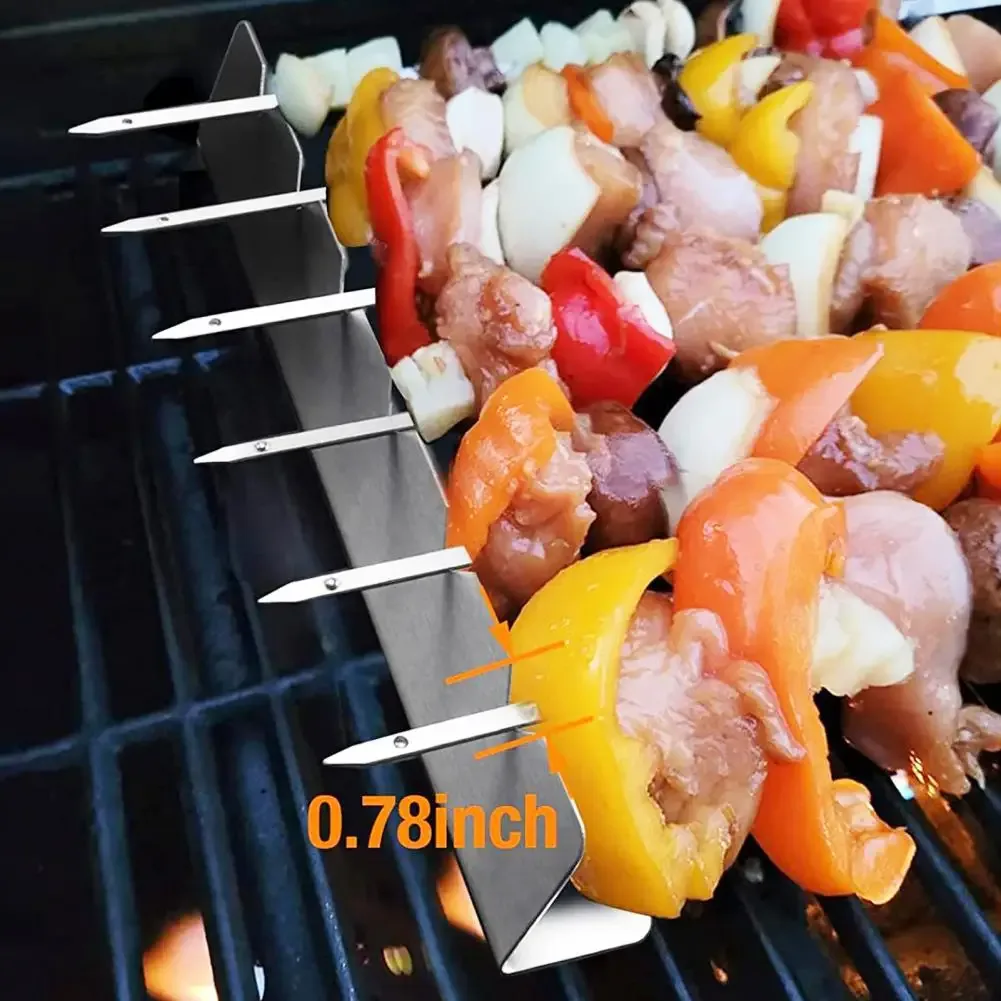
Our recommendation depends on what you grill most often. For beef, chicken, and lamb, flat stainless steel is the clear winner. Get the widest blade that fits through your food, usually 1/2-inch to 3/4-inch wide.
For delicate shrimp, small scallops, or small veggie skewers, thin bamboo is fine because those items cook so fast. If you're grilling for a crowd and don't want to wash anything, bamboo soaked for 30 minutes is still a solid choice. Just know that you'll need to watch the tips and turn more frequently.
Direct Heat or Two-Zone? Matching Your Grill Setup
The heat setup decides how the outside browns while the inside catches up. It's the difference between seared-but-even kebabs and a burnt exterior with a raw center. Matching your grill type to a two-zone layout is the most reliable habit in this entire guide.
If you have a gas grill, set half the burners to high and the other half to low or off. That's the simplest two-zone setup there is. You start the skewers over the hot side.
Cook them there for 2 to 3 minutes per side to build color. Once every side has a good sear, move the skewers to the cool side. Close the lid.
Let the indirect heat finish the centers. This works especially well for chicken, which needs more time to reach 165°F. You don't have to babysit flare-ups because the fat drips away from the flames on the indirect side.
If you're cooking on charcoal, bank the coals to one side. Leave the other side empty. That creates a hot zone directly over the coals and a cool zone on the empty side.
Charcoal gives you higher direct heat than gas, usually 500°F to 700°F at grate level. That's great for a fast sear but dangerous for finishing. The answer is the same.
Sear over the coals, then slide the skewers to the empty side. Put the lid on with the vent positioned over the food, not the coals. That pulls heat across the skewers without direct flame.
As of and 2026, most charcoal kettles still follow the same basic airflow setup. The vent position controls the convection.
If you only have a single-burner portable grill or no indirect zone at all, you can fake two-zone heat with the lid. Sear the skewers with the lid open over medium-high heat. Then turn all burners down to low, close the lid, and let the trapped heat finish the inside.
The cooking surface stays hot, but there's no direct flame hitting the food. It's not perfect, but it works. The key here is not to leave the skewers over high flame the whole time.
That never ends well for a thick piece of chicken or lamb.
Now here's the decision tree part, because your fuel changes the timing. If you're grilling beef cubes for medium-rare, you want mostly direct heat with minimal indirect time. Sear each side for 2 minutes and pull them when the internal temp hits 135°F.
Resting will carry them to 140°F. If you're grilling chicken, the opposite is true. Give chicken 2 to 3 minutes per side on direct heat, then move to indirect and let it coast up to 165°F.
If you're doing vegetable-only skewers, skip the long indirect step. They're done when they have soft edges and a little char.
Oneymore thing: oil your grill grate before loading skewers. A clean, oiled hot grate prevents sticking. That means fewer torn chicken pieces and fewer broken veggie chunks.
Spray or wipe a high-smoke-point oil like avocado or grapeseed onto the grates while they're hot. Do this right before you place the skewers down.
Prepping Protein and Vegetables for Uniform Doneness
Preparation is where most even-cooking problems are either created or solved. You can have the best grill setup and the nicest skewers, but if the food goes on unevenly cut, the result will be uneven. The cutting board is the first cooking surface.
Start with protein. Trim everything into uniform cubes, 1 inch to 1.25 inches on each side. That means nothing bigger than a standard walnut in its shell.
Chicken breast, beef sirloin, lamb leg, and pork loin all work well. Avoid cuts with heavy connective tissue like beef chuck or pork shoulder. They need long slow cooking, which doesn't match a kebab's fast direct heat.
Use a sharp knife and cut against the grain for tenderness. If you're working with chicken thighs, remove the large fat pockets and slice them into pieces that are thicker than they are wide. Thigh meat is more forgiving than breast, so a little size variation is okay.
For vegetables, think about their moisture and density. Onions and bell peppers have high water content and soften quickly. Zucchini cuts into similar shapes and cooks fast.
Mushrooms shrink by nearly half, so keep them slightly larger. Cherry tomatoes burst under high heat, so skewer them whole and don't overcrowd them. Dense root vegetables like carrots, potatoes, or parsnips need par-cooking.
Boil or steam them for 3 to 5 minutes before skewering. Otherwise they'll still be crunchy long after the meat is done.

Here's the core principle: protein and vegetables rarely finish at the same time. If you thread them together on one skewer, one or the other will be overdone. The easier fix is to use separate skewers, one for meat and one for veggies.
That way you can pull the vegetables when they're tender and leave the meat on a bit longer. Many restaurants do this exact thing while still serving them together on the plate.
Marination also matters for even browning. A thick, sugary marinade will caramelize fast and burn before the inside cooks. If your marinade contains honey, brown sugar, or barbecue sauce, apply it only during the last few minutes of grilling.
Or thin it with oil and acid. Wet surfaces also cause steaming. Pat the cubes dry with a paper towel before they hit the hot grate.
That gives you a clean sear instead of a pale boiled look. Always follow USDA safe handling guidelines for raw meat. Keep protein refrigerated until the moment it hits the skewer.
Don't let marinated raw chicken sit on a sunny patio for an hour. That's a safety issue and it also changes how the meat cooks.
Spacing prep still matters before you ever pick up the skewer. If every cube is uniformly 1 inch, the gap becomes easier to control. You'll thread them the same way every time.
If some cubes are 1.5 inches and others are 3/4 inch, the small ones will be done in half the time and start shrinking. The skewer then becomes uneven in a whole new way, with loose pieces shifting around. A little uniformity at the cutting board saves you constant turning and checking at the grill.
How to Thread Skewers So Every Piece Gets Equal Heat
Push each piece onto the skewer through its center. Leave a small gap between pieces, about 1/4 to 1/2 inch. That gap lets hot air reach all four sides.
It also prevents the pieces from steaming each other.
Start with a sturdier piece like a chunk of onion or bell pepper. It anchors the end. Don't thread anything too tightly or the inner faces stay pale.
For mixed skewers, keep meat and veggies on separate rods. They finish at different times.

Step-by-Step Grilling Method for Even Caramelization
Heat your grill with two zones ready. Oil the grates. Place skewers diagonally across the grate rods so they don't fall through.
Sear each side for 2 to 3 minutes over direct heat. Turn a quarter turn with tongs, not by hand. After all sides show color, move to indirect heat.
Close the lid. Check internal temperature before pulling. Rest for 3 minutes.
Common Mistakes That Lead to Burnt Edges and Raw Centers
Overpacking the skewer is the top mistake. Pieces pressed together steam and won't sear evenly. Sugary marinades applied too early burn before the inside cooks.
Wet meat hits the grill and boils instead of browning.
Flipping too often also hurts. Give each side enough contact time to form a crust. And never grill frozen cubes.
The outside scorches while the center stays cold.
Skewer-by-Skewer Decision Guide: Best Combos for Chicken, Beef, Shrimp, and Veggies
| Protein | Direct Heat Time | Finish Method | Target Temp |
|---|---|---|---|
| Chicken | 2-3 min per side | Indirect, lid on | 165°F |
| Beef | 2 min per side | Pull after sear | 135-140°F |
| Shrimp | 1-2 min per side | No indirect needed | Opaque, firm |
| Veggies | 2 min per side | Grill separate | Soft edges |
If chicken is your main protein, lean on indirect heat longer. If beef, keep it mostly direct and pull early. Shrimp needs almost no indirect time.
Vegetables go on their own skewer and come off when tender.
Safety and Temperature Targets for Perfect Kebabs
Follow USDA minimums. Chicken and pork must hit 165°F. Beef and lamb are safe at 145°F for medium-rare.
Shrimp is done when opaque and firm.
Use a clean plate for cooked skewers. Raw chicken juice on a cutting board spreads bacteria fast. Wash anything that touched raw meat before it touches cooked food.
Let beef rest a few minutes so the temperature settles.
Expert Tips for Charring Without Flare-Ups
Trim visible fat before cubing. Fat dripping onto hot coals causes flare-ups. Pat the skewers dry before they hit the grate.
If flames jump up, move the skewers to the indirect side for thirty seconds. Don't spray water onto a grease fire. Lift and relocate instead.
Frequently Asked Questions About Grilling Kebabs Evenly
How long should I soak bamboo skewers?
Soak them for 20 to 30 minutes in warm water. Fully submerge them. Longer soaking makes them waterlogged and weak.
Can I put meat and vegetables on the same skewer?
Yes, but they finish at different times. Separate skewers give you better control over doneness for both.
What temperature should chicken kebabs reach?
Cook chicken to 165°F measured in the thickest piece. Let it rest for three minutes before serving.
Why do my kebabs spin when I turn them?
Round skewers let food rotate freely. Flat metal skewers grip the food and stop that spinning.

Similar Posts



















