Grill Frozen Burgers Safely: Tips for Juicy Results
You've got a freezer full of ground beef patties and a rumbling stomach. The last thing you want to do is wait around for them to thaw. So, can you toss them straight on the grill?
Absolutely. Learning how to grill frozen burgers safely is a game-changer for busy weeknights and impromptu cookouts, and it's easier than you think.
The secret isn't just about heat; it's about precision. The USDA mandates that ground beef must reach an internal temperature of 160°F to be safe, and cooking from frozen doesn't change that rule. You just need a slightly different game plan than you would with fresh patties.
Let's walk through the exact process so you get a juicy, safely cooked burger every single time.

Quick Answer
Grill frozen burgers over medium-high heat. Cook them for 6, 8 minutes per side. Always check the internal temperature.
It must hit 160°F in the center. Use an instant-read thermometer. Don't rely on color.
Why Frozen Burgers Need Special Handling
Here's the thing about a frozen patty: it's not just a colder version of a fresh one. When beef freezes, the water inside expands and forms ice crystals. Those crystals puncture the muscle fibers, which changes how the meat cooks.
As the patty heats up, the outer layers cook and brown quickly, but the center stays cold and raw for much longer.
That's the trap. You can get a beautiful, deeply charred crust on the outside while the inside is still sitting in the danger zone between 40°F and 140°F. That temperature range is where bacteria like E. coli and Salmonella multiply fastest.
And because ground beef combines meat from many animals, the risk of contamination is higher than with a whole steak.
That's also why the "cut it open and check the color" trick fails you with frozen patties. A frozen burger can look perfectly brown and done on the inside while still being undercooked. The myoglobin in the meat behaves differently when it's been frozen, so the visual cues you rely on with fresh meat simply vanish.
The only way to win this game is with accurate temperature data.
The Golden Rule: 160°F, No Exceptions
Let's make this crystal clear: ground beef must reach 160°F. That is the USDA Food Safety and Inspection Service standard, and it is non-negotiable for a safe burger. At that temperature, harmful pathogens that might be present are destroyed within seconds.
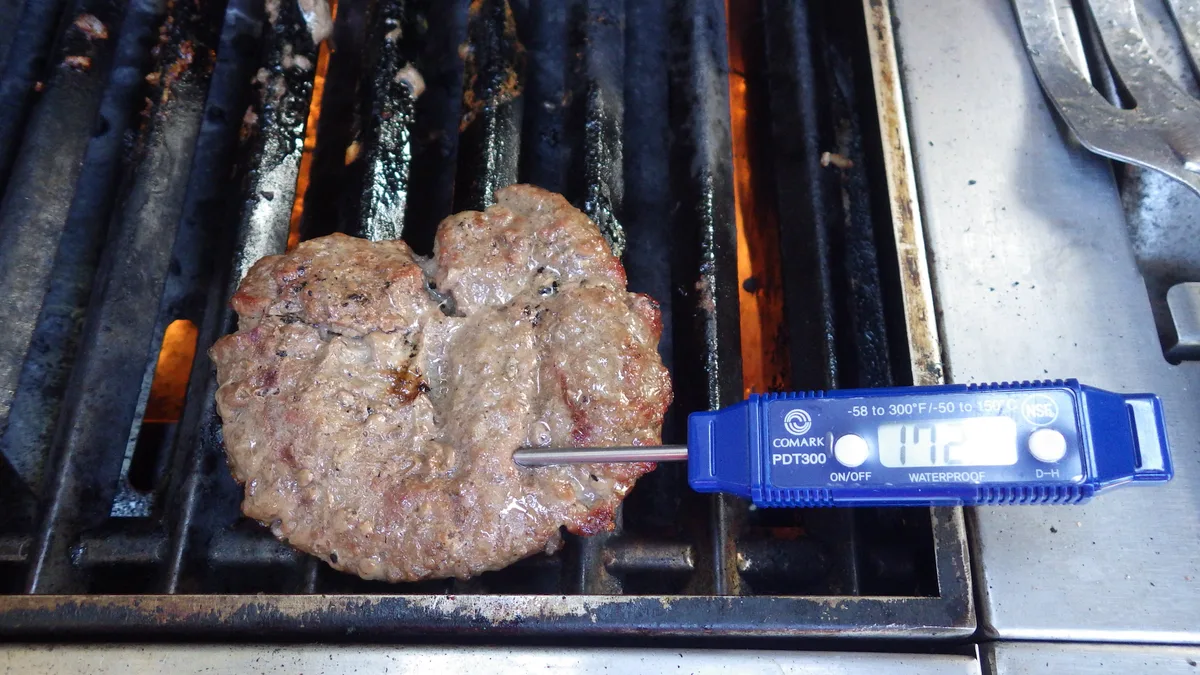
Now, here's the part most people mess up. You can't just stick the thermometer probe into the top of the patty. The heat radiates up from the grill grate, so the top of the burger might be cooler than the center.
Instead, insert the probe horizontally through the side of the patty, aiming for the dead center. This gives you the truest reading of the coldest part of the meat.
Aggregate reviews of grilling mishaps show that most undercooked burgers are the result of someone guessing. They pressed the patty, felt it was "firm enough," and called it done. Firmness means nothing with frozen meat.
Springiness means nothing either. Only a calibrated digital thermometer gives you the truth. A good instant-read model responds in 2 to 3 seconds, and as of 2026, accurate models are affordable enough that there's no excuse not to own one.
What You'll Need Before You Start
You don't need a dozen fancy gadgets. But skipping the essentials is how you end up with a hockey puck or a trip to urgent care. Here's the simple checklist.
| Tool | Why You Need It |
|---|---|
| Instant-read thermometer | Non-negotiable. Confirms 160°F internal temperature. |
| Grill (gas or charcoal) | Any grill works. You just need steady medium-high heat. |
| Thin metal spatula | Slides under the patty without tearing it. |
| Tongs | For flipping safely without piercing the meat. |
| Paper towels | For oiling the grate. |
| High smoke-point oil | Vegetable, canola, or grapeseed oil for the grate. |
| Dry seasoning or rub | Salt, pepper, garlic powder. Skip wet marinades. |
| Aluminum foil | For tenting the burgers after they rest. |
As for the patties themselves, thicker doesn't mean better. A ¾-inch thick patty is the sweet spot. It's thick enough to stay juicy but thin enough to cook through without charring the outside into a bitter shell.
If you buy pre-formed frozen patties from the store, check the label for the actual fat content. An 80/20 blend (80% lean, 20% fat) will give you the best balance of flavor and moisture. The 90/10 blends are leaner but tend to dry out faster on the grill.
Step-by-Step: How to Grill Frozen Burgers Safely
This is the whole process, from cold freezer to hot bun. Follow these steps in order, and you'll nail it.
Step 1: Preheat Your Grill Properly
Your grill needs to be hot before the patties hit the grate. Target a surface temperature between 400°F and 450°F. If your grill has a lid thermometer, dial it to medium-high and close the lid.
Give it a full 10 to 15 minutes to heat up. A cold grate will stick, and a barely-warm grate will slowly steam the outside of your patty instead of searing it.
Once it's hot, dip a folded paper towel in oil, hold it with tongs, and rub it over the grate. This creates a non-stick surface. It also helps you achieve those crisp, dark sear marks that add flavor.
Step 2: Season Before They Hit the Grate
Here's a tip a lot of people miss. Season frozen patties before they go on the grill, not after. As the outside thaws and heats up, it will absorb the salt and spices.
If you wait until after cooking, the seasoning just sits on the surface and falls off.
Use a dry rub. Salt, black pepper, garlic powder, and a dash of smoked paprika works great. Don't use a wet marinade.
It will just slide off the icy surface and cause flare-ups.
Step 3: Place, Close the Lid, and Don't Touch
Lay the patties on the hot grate. Then, close the lid. This traps the heat and helps cook the patties more evenly.
Let them cook undisturbed for 6 to 8 minutes.
Do not press down with the spatula. I know it's tempting. That sizzling sound makes you want to smash them flat.
But you're literally squeezing out the juices, and you're also pushing raw beef juice onto the grill where it can cause flash fires. Let them sit.
Step 4: Flip Once — and Only Once
After 6 to 8 minutes, slide your thin metal spatula underneath the patty. If it resists, it isn't ready. Let it cook another minute, then try again.
A properly seared patty releases cleanly. Tear it if you flip too early.
Flip it once, and then close the lid again. Cook for another 6 to 8 minutes on the second side. That's it.
Flip once, leave it alone, and let the heat do its job.
Step 5: Check Temperature Like a Pro
After the second side has cooked for about 6 minutes, start checking. Insert your instant-read thermometer horizontally through the side of the patty, into the middle. The reading needs to be 160°F.
If it's not there yet, close the lid and give it another 2 to 3 minutes. Check again. Repeat until you hit the mark.
Don't rush this step, and don't pull the burgers early.
Step 6: Rest and Serve
This is the step everyone skips. Pull the burgers off the grill and place them on a clean plate. Tent them loosely with a piece of aluminum foil.
Let them rest for 3 to 5 minutes.
During that time, the carryover cooking effect pushes the internal temperature up by another 5°F or so. This also lets the juices redistribute throughout the meat. If you cut into a burger right off the grill, those juices run out onto the plate, leaving you with a dry patty.
Resting keeps them locked inside.
The Biggest Mistakes People Make with Frozen Patties
Even experienced grillers make these errors. And with frozen meat, the consequences are worse. Here's what to avoid.
- Pressing down with a spatula. It squeezes out the juices and pushes raw juice onto hot coals, causing flare-ups. It also cooks the meat unevenly.
- Cutting into the burger to check. This releases all the juices, dries out the meat, and it still doesn't tell you if the center is safe. Only a thermometer does that.
- Flipping too often. Every flip loses heat and delays the sear. You end up with a tough, gray patty instead of a crusty one.
- Using a "poke test". The old "compare firmness to your thumb" trick is unreliable with any meat. With frozen patties, it's absolutely useless.
- Salting too early. If you salt the patties and then leave them out at room temperature for a while, the salt pulls moisture to the surface. This creates a dry, dense burger. Season right before grilling.
- Adding cheese too early. If you add cheese in the last minute, it melts on a hot surface. If you add it too early, it melts off the sides and burns on the grate. Wait until the internal temp is about 155°F, then add the cheese and close the lid for the last 60 seconds.
How Frozen Grilling Compares to Thawed Grilling
So, is it worth the extra time to thaw your patties first? The short answer is: it depends on what you're optimizing for. Each method has real trade-offs, and knowing them helps you make the right call for your specific situation.
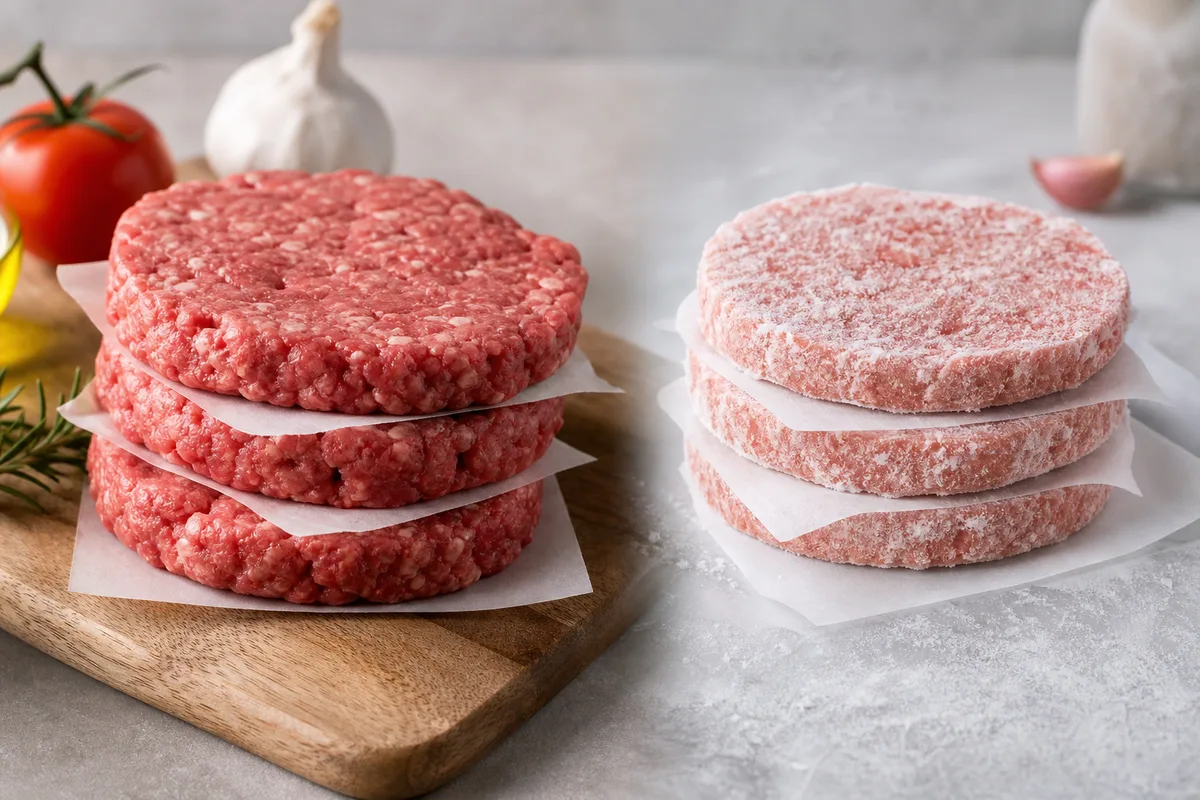
The biggest difference is cook time. A thawed ¾-inch patty typically needs 4 to 5 minutes per side. A frozen one needs 6 to 8 minutes per side.
That's roughly 40% to 60% longer, which matters when you're feeding a crowd and the grill is full.
| Factor | Frozen Patties | Thawed Patties |
|---|---|---|
| Cook time (¾-inch) | 6–8 min per side | 4–5 min per side |
| Juice retention | Good, if handled right | Better, typically |
| Risk of overcooking | Higher | Lower |
| Convenience | Excellent | Requires planning |
| Texture | Slightly denser | More tender |
Thawed patties win on texture. When meat isn't frozen, the muscle fibers stay relaxed, and they hold onto moisture differently. You get a softer, more tender bite.
Frozen patties, on the other hand, tend to be slightly denser because the ice crystals have physically damaged some of those fibers.
But here's the thing. For most home cooks, the difference is subtle. If you're using a decent 80/20 blend and you nail the 160°F target, a frozen burger can be nearly indistinguishable from a fresh one.
The convenience factor often outweighs the slight texture trade-off, especially on a busy weeknight.
If you're hosting a backyard barbecue where burgers are the star, thawing overnight in the fridge is the better play. If you're cooking for yourself on a Tuesday night after work, frozen-direct is the clear winner. Neither is wrong.
It's about matching the method to the moment.
The Right Way to Store and Freeze Burger Patties
If you're going to grill frozen burgers, you need patties that freeze well in the first place. Store-bought frozen patties are fine, but homemade ones give you control over fat content, seasoning, and thickness. The problem is that most people freeze them wrong and end up with a solid block of meat.
The solution is simple: separate your patties with parchment paper. Form your patties, place them on a baking sheet in a single layer, and freeze them for about 30 minutes. Once they're firm, stack them with a square of parchment paper between each one, then wrap the stack tightly in plastic wrap and aluminum foil.

That extra layer matters. Freezer burn happens when air reaches the meat's surface. The cold, dry air in your freezer pulls moisture out of the beef, leaving behind white or grayish patches that taste stale and cardboard-like.
Airtight wrapping prevents that.
As for shelf life, the USDA recommends using ground beef within 3 to 4 months for the best quality. It stays safe indefinitely in the freezer, but the flavor and texture degrade over time. Label your packages with the date so you don't play freezer roulette six months later.
One more thing. Never leave frozen patties on the counter to "quick thaw." That puts the outer edges in the danger zone while the center stays frozen solid. If you forget to thaw ahead of time, just grill them frozen.
That's the whole point of this article.
Can You Grill Frozen Burgers on Any Grill?
Frozen burgers are forgiving when it comes to equipment. Whether you're working with gas, charcoal, or a pellet grill, the core principles stay the same: preheat properly, cook over medium-high heat, and verify the internal temperature.
Gas grills are the easiest. They heat up fast, and you can dial in a consistent 400°F to 450°F zone with the turn of a knob. That consistency makes hitting your cook times predictable.
Charcoal grills need more attention. You've got to manage the airflow and wait for the coals to ash over, which takes 15 to 20 minutes. But charcoal gives you that smoky flavor that gas can't replicate.
Pellet grills work fine too, but they're better suited for low-and-slow cooking than direct searing. If you're using one, crank it to its highest setting and give it plenty of time to come up to temperature. You might not get the same aggressive sear as charcoal, but you'll still get a properly cooked burger.
Indoor grill pans and electric griddles are viable backup options. The key difference is heat recovery. Indoor electric grills often drop in temperature when you load them with cold food, so they need a few extra minutes to bounce back.
Just be patient and let the patties cook without constantly opening the lid.
If you're at high altitude, keep in mind that water boils at a lower temperature. This doesn't change your target of 160°F for the burgers themselves, but it can affect total cooking time. Monitor with your thermometer, not the clock.
Expert Tips for Juicy Frozen Burgers Every Time
You've got the basics down. Now let's talk about the finer points that separate a good burger from a great one. These are the small adjustments that experienced grillers use to get consistently better results.
First, use a ¾-inch patty, but don't go thinner than half an inch. Thin frozen patties overcook in a flash. The outside burns before the center ever gets close to 160°F.
If your patties are too thin, lower the grill heat to around 375°F and cook them a bit slower.
Second, know that carryover cooking is your friend. When you pull a patty off the grill at 155°F, it will continue to climb to 160°F or 162°F while resting under the foil. That buffer zone gives you a little forgiveness if your timing is slightly off.
Third, don't overcrowd the grill. If you pile five patties on a small grate, the temperature drops instantly, and the patties start steaming instead of searing. Give each patty at least an inch of space on all sides.
For a standard 22-inch grill, that means about 4 to 6 patties per batch, depending on size.
Fourth, try a compound butter. Mix softened butter with chopped herbs and garlic, then freeze it in a log. Slice it and place a coin-sized disc on top of each hot, resting burger.
The butter melts into the patty and makes it taste like it came from a steakhouse.
Finally, toast your buns. While the burgers rest, throw the buns on the hot grill for 30 to 45 seconds, cut-side down. They pick up light grill marks and a subtle char that transforms the whole sandwich.
A little mayo brushed on the cut side spreads better than butter and browns just as nicely.
Common Questions About Cooking Frozen Beef Patties
Is it safe to cook frozen burgers without thawing first?
Yes, it is completely safe. The USDA confirms that you can cook frozen ground beef directly from the freezer, as long as you bring it to the safe minimum internal temperature of 160°F. The cooking time is longer, but the safety endpoint is the same as fresh meat.
How do I know when my frozen burger is done?
Use an instant-read thermometer, and do not skip this step. Insert the probe horizontally through the side of the patty, aiming for the geometric center. The digital readout must show 160°F before you pull it off the grill.
Do not rely on color, firmness, or cooking time alone.
Should I flip frozen burgers more than once?
No. Flip once, roughly halfway through the total cooking time. Frequent flipping prevents the surface from forming a proper sear, and it lowers the overall grill temperature.
A single, deliberate flip gives you a crusty exterior and a more consistent internal cook.
Can I add cheese to frozen burgers?
Yes, but wait until the end. When your patty hits about 155°F, place a slice of cheese on top and close the lid for 60 seconds. The residual heat melts the cheese without burning it.
Adding cheese too early causes it to slide off and scorch on the grate.
How long can I keep frozen burger patties in the freezer?
For the best quality and flavor, use them within 3 to 4 months. The meat stays safe to eat indefinitely at 0°F, but freezing longer than that leads to freezer burn and a loss of moisture. Always wrap patties tightly to prevent air exposure.
Frequently Asked Questions
Can I put cheese on while the burger is still frozen?
Yes, but wait until the very end of cooking. Add cheese when the internal temperature hits about 155°F, then close the lid for 60 seconds. This melts the cheese without burning it or turning it into a mess on the grate.
How do I know if my frozen burgers have gone bad?
Check for freezer burn patches, which look like grayish-white dry spots. If the patties smell sour or ammonia-like, toss them. When in doubt, throw it out.
Is it safe to refreeze thawed burger patties?
No. Once ground beef has thawed in the refrigerator, refreezing it degrades texture and increases bacterial risk. If your patties were thawed in the microwave or cold water, cook them immediately rather than refreezing.
Why does my thermometer give different readings each time?
Your probe might not be hitting the true center. Insert it horizontally through the side and make sure the probe tip sits in the middle of the patty. Also, check that your thermometer is calibrated by testing it in a glass of ice water; it should read 32°F.
Final Verdict: Is It Worth It?
Grilling frozen burgers directly is absolutely worth it when you're short on time or didn't plan ahead. The process takes about 15 to 20 minutes total, and the results are reliably juicy and safe when you follow the temperature rule.
The honest trade-off is texture. Thawed patties will always have a slight edge in tenderness. But for most home cooks, the convenience of pulling patties straight from the freezer outweighs that small difference, especially on a busy weeknight.
If you take one thing from this guide, let it be this: always verify 160°F with a thermometer. That single habit transforms frozen burger grilling from a risky guess into a foolproof method. Pair it with a hot grill, a single flip, and a proper rest, and you'll never hesitate to cook from frozen again.
For more detailed food safety guidelines, check the USDA Food Safety and Inspection Service for their official recommendations on handling ground beef.

Similar Posts



















